
A shower tray is built to last for years, yet it gets damaged more often than a bathtub. The reason is how the load lands: all the weight presses on the same spot of the floor, day after day, and eventually a deep crack opens. Add a dropped bottle or shower head, and you get chips, deep scratches — sometimes a hole.
Can a shower tray be reglazed?
Why pour-on works
Choosing a shower pan
Tray materials compared
Replacing a damaged tray is always an option. But it means taking the enclosure apart, pulling the old tray, installing a new one and redoing the plumbing — a lot of work and expense for what is usually a surface problem. That’s why reglazing a tray in place has become a common repair.

How a shower tray is reglazed
Pour-on enamel bonds to steel, cast iron, ceramic and most other tray materials, so the same method used on bathtubs works on shower bases. The job goes in five steps.
- Inspection. Every chip, crack and worn spot is located before any work starts — this decides how much repair the tray needs.
- Structural repair. Minor defects are fixed with the tray in place. A through-crack or a hole has to be reinforced and bonded from the underside first, then filled with putty.
- Stripping. The old top layer is sanded off with abrasives, with extra attention to the damaged areas, and the surface is leveled.
- Cleaning. All dust and residue of the old coating are removed and the tray is degreased, so the new enamel can bond.
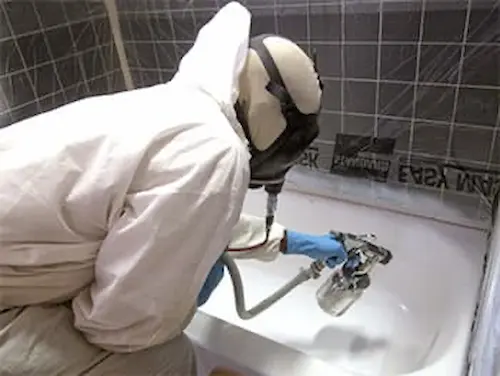
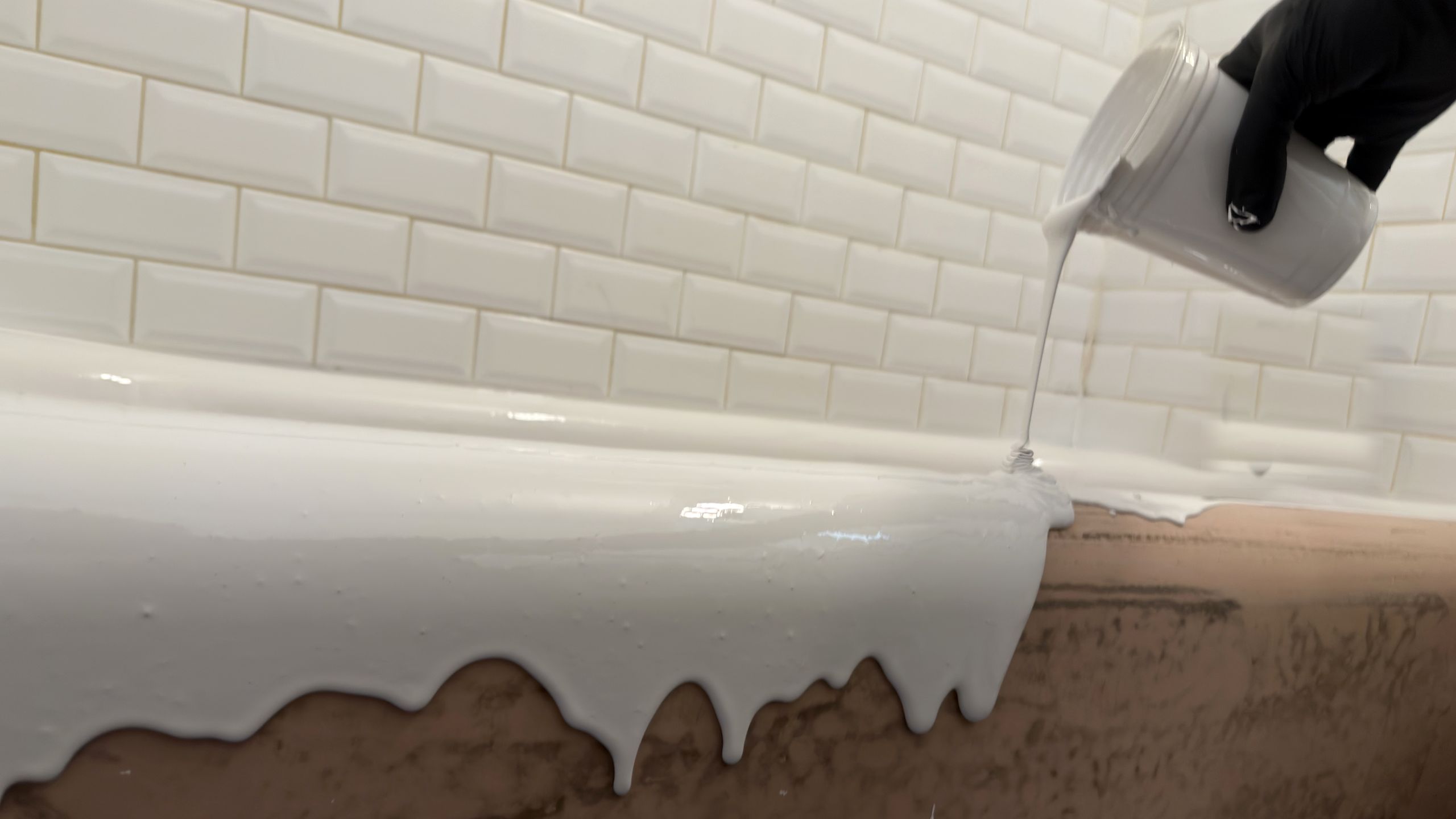
- Pouring. The enamel is spread evenly across the tray, filling every crack and defect as it goes. It self-levels and needs no brushes or rollers — nothing to leave marks — so the finished surface comes out flat and mirror-smooth.
What pour-on enamel gives a shower tray
Fast turnaround
A few hours of work, then 1–2 days for the enamel to cure. Far quicker than tearing out and replacing the tray.
No fumes
The enamel gives off no toxic vapor and has no smell — during the work and for the life of the coating.
Long service life
A wear-resistant coating that lasts around 15 years, sometimes longer, and keeps its looks the whole time.
Stronger than before
Excellent adhesion means the layer becomes one with the tray, adding strength and flexibility and resisting new damage.
Easy upkeep
A smooth, non-porous surface doesn’t trap dirt. A wipe with a soft cloth is enough.
Not slippery
Wet enamel and ceramic can be dangerous underfoot; a pour-on surface gives noticeably better grip.
Choosing a shower pan
Many bathrooms simply don’t have room for a tub, and plenty of people prefer a quick shower anyway. If an off-the-shelf enclosure doesn’t fit your space, you can build one around a tray that does.
Size and shape
Pick the base by the room and by who’s using it. In a small bathroom, a corner tray with a rounded or five-sided front edge saves the most space. If there’s room, a square tray up to about 5 ft (1.5 m) a side gives a generous walk-in shower; round, oval and polygonal trays exist for custom layouts. Whatever you save in space, make sure everyone in the household can still shower comfortably.
Depth
Deep trays exist — some people even use them for a sitting bath — but a high step is a problem for older family members and anyone with mobility issues. Choose depth purely by who will be stepping in and out.
Extras
A tray with a built-in seat is worth it for seniors, and children like it too. Look at the floor finish: soapy water on a smooth surface is a slip hazard, so a textured bottom or non-slip inserts help. Mats solve the same problem but get in the way of cleaning.

Shower tray materials compared
The material decides how long the tray lasts, how hard it is to move and install, what can be attached to it — and what it costs.
Cast iron
Powder-enameled like a cast-iron tub: very long-lived, wear-resistant, quiet and slow to lose heat. Downsides are the serious weight and a limited choice of shapes.
Steel
Reliable and durable, but heavy and loud under running water. The enamel on steel trays chips and cracks more often than on other materials.
Ceramic
Looks good, dampens noise, easy to clean and maintain. The trade-off: the material is brittle and expensive.
Marble
The choice for a luxury bathroom, excellent to look at and to use. The price puts it out of reach for most buyers.
Acrylic
A good balance of everything: durable with proper care, offered in a huge range of shapes. Needs a support frame underneath so the tray doesn’t flex.
Quaryl
Acrylic reinforced with quartz dust — stronger, stiffer and longer-lasting than plain acrylic.